Side by side
| Criterion | Rascasse | Nielsen Sports |
|---|---|---|
| Primary question | Which property fits, and did behaviour respond? | How much exposure was generated, and what is it worth? |
| Method | AI-based analysis of aggregated digital behaviour signals (search, social, video, events, sponsorships, points of interest), not surveys | Exposure detection and media valuation, plus fan research |
| Coverage | 500,000+ data points in 200+ countries, including 50,000+ brands and 100,000+ media channels; 31,000+ sponsorship deals (18,000+ sponsors, 57 sports, 130 countries) | No overall market count published |
| Partner search before signing | Yes: screening across the full field of properties | Research-led service |
| Exposure detection | No. We do not measure broadcast exposure | Yes: the core capability |
| Media valuation | No | Yes |
| Behaviour response | Yes: share of search and social signals before and after, against competitors and on match days | Fan research and brand studies |
| Finest geographic level | Region, city and postal code, where available | Market |
| Access | Web (Rascasse Solution), exports and decks; API and MCP as part of your agreement | Managed service and online access |
Where Nielsen Sports is stronger
- Exposure detection. Identifying and quantifying brand visibility across broadcast and digital coverage is a substantial technical capability that we do not have and do not claim.
- Media valuation. Turning exposure into a money figure against media rates is an established method, and rights holders price against it.
- Accepted as a reporting currency. Nielsen valuations are widely used in sponsorship reporting, which matters when a counterparty has to recognise the number.
- Research and strategy services. A research practice around sponsorship strategy, which is a service capability rather than a data one.
Where Rascasse is stronger
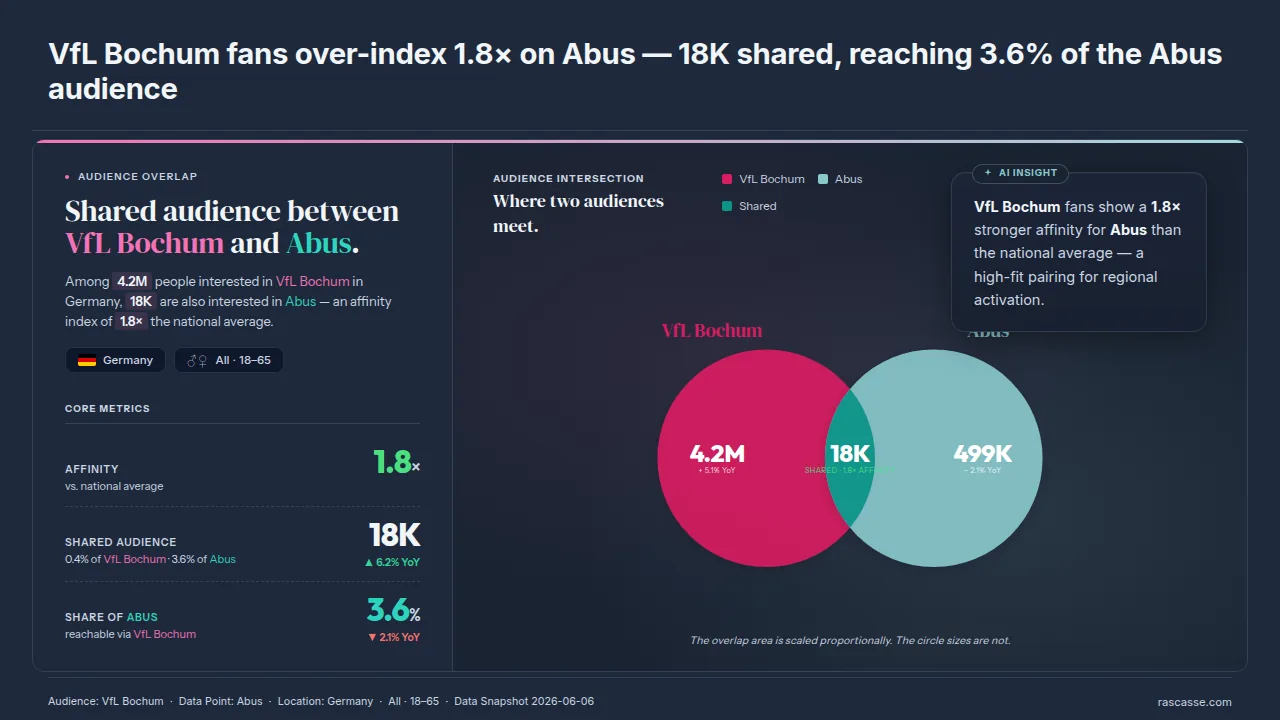
- Selection before signature. Screening the full field of properties on audience overlap, affinity and geography, including those not on a shortlist yet. Much of a sponsorship's value is decided here, before there is any exposure to measure. See sponsorship matching.
- Geographic resolution. Audience concentration by region, city and postal code, where available. It shows whether a property's audience sits inside the sponsor's sales footprint.
- Response, not only exposure. Share of search and social signals for the sponsor and its competitors, before and after the deal and on every match day. See sponsorship impact.
- Beyond the major leagues. Smaller properties, music, events and emerging sports, where audience data is usually thinnest and pricing least efficient.
- A number finance can follow. Fit and response shown as charts with both periods, absolute values and the change, so a budget owner can check the argument.
Exposure is not response
Media value describes the scale of exposure a sponsorship generated. It does not establish that anyone noticed, and it cannot tell favourable coverage from unfavourable. The industry's own evaluation framework, the Barcelona Principles maintained by AMEC, states that advertising value equivalency is not the value of communication. See media value and AVE.
That is not an argument against measuring exposure. Exposure is real, and properties should be compared on it. It is an argument for reporting response alongside it: did people search for and follow the sponsor more than its competitors after the deal, and on match days compared with days without a match? This is strong evidence, not a controlled experiment, and we say so in every report.
When to use both
The sequence that makes both work: behaviour analysis to select the property on audience fit and geography, exposure measurement to verify the rights were delivered as contracted and to compare visibility, and behaviour signals to show whether the audience responded. Each step answers a question the others cannot. For a sponsor this is also the return-on-investment argument: the fee is justified by fit before signing and by response after, not by seconds on screen alone.
Making the case to finance
Whichever provider you choose, the budget owner will ask what it costs, what it delivers and how to check it. With Rascasse the Annual fee per market or region is agreed upfront, own audiences come as credits (one credit is one audience in one country), and every result is a chart, a deck or an export that someone outside the analysis can check. Teams without their own analysts can buy the answer instead, as an Insights Report.
How to test it
The fair test is one real question, answered both ways. Pick a question you already answer with Nielsen Sports, for example which three properties fit your brand best in one market, or whether your current deal moved share of search against your competitors. In a Proof Case we answer it for one market and up to three audiences in three weeks, at a fixed price, and present the result to the person who decides on the budget. You then put both answers next to each other and judge where the difference matters for your decision.
Sources
- Nielsen Sports overview: https://content.nielsen.com/sports/overview, retrieved 13 September 2026.
- Barcelona Principles, maintained by AMEC (International Association for the Measurement and Evaluation of Communication).
- Rascasse figures: our own published coverage, October 2026.
We do not measure or test other providers' products. Everything stated about them here is their own published claim or description. If a figure has changed, tell us and we will correct it.