
Home / Audience Intelligence / Audience Profiling
Audience Profiling · for brands, agencies, media and rights holders
Understand your audience like never before.
New or existing, broad or niche: Rascasse describes any audience with 100,000+ data points across every part of life, and lets you slice it by region, city, postal code, age, gender and, in the US, ethnicity.
- 100K+ data points per audience
- 200+ countries
- 24h to a new audience
Used by brands, agencies, media and rights holders











How we read the signals
One audience. Every part of their lives.
We describe an audience by what it actually does online: what it searches, follows, watches and listens to. Every signal is compared with the population, so you see what makes this audience different, not what everyone does.
- 100,000+ data points per audience, from brands and media to people, events, places and topics.
- Affinity: how much more likely the audience is to engage with something than the average person. 2.0× means twice as likely.
- Any slice: region, city, postal code, custom locations, age, gender and ethnicity in the US.
What slows you down
Most audience research describes a panel, not your audience
Surveys capture what respondents think sounds right, not what they actually do.
“Outdoor enthusiasts, 25–44” is a panel cell. Your customers of one brand in one city are not.
Studies age fast. By the time the report is out, the audience has moved on.
Every new market means a new study, a new method and numbers you cannot compare.
Who they are, at a glance
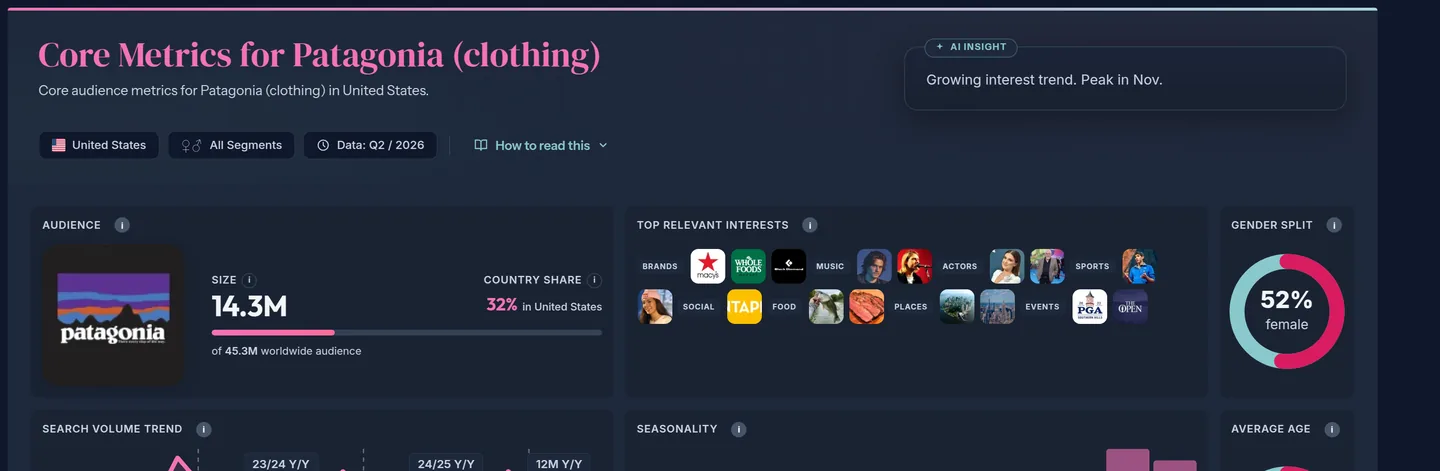
Size, share of the population, gender, age, search interest over four years and the months when interest peaks, plus the brands, media and people the audience follows most.
- Patagonia in the US: 14.3 million people
- 52 % women, average age 41
- Interest peaks in November
What they value
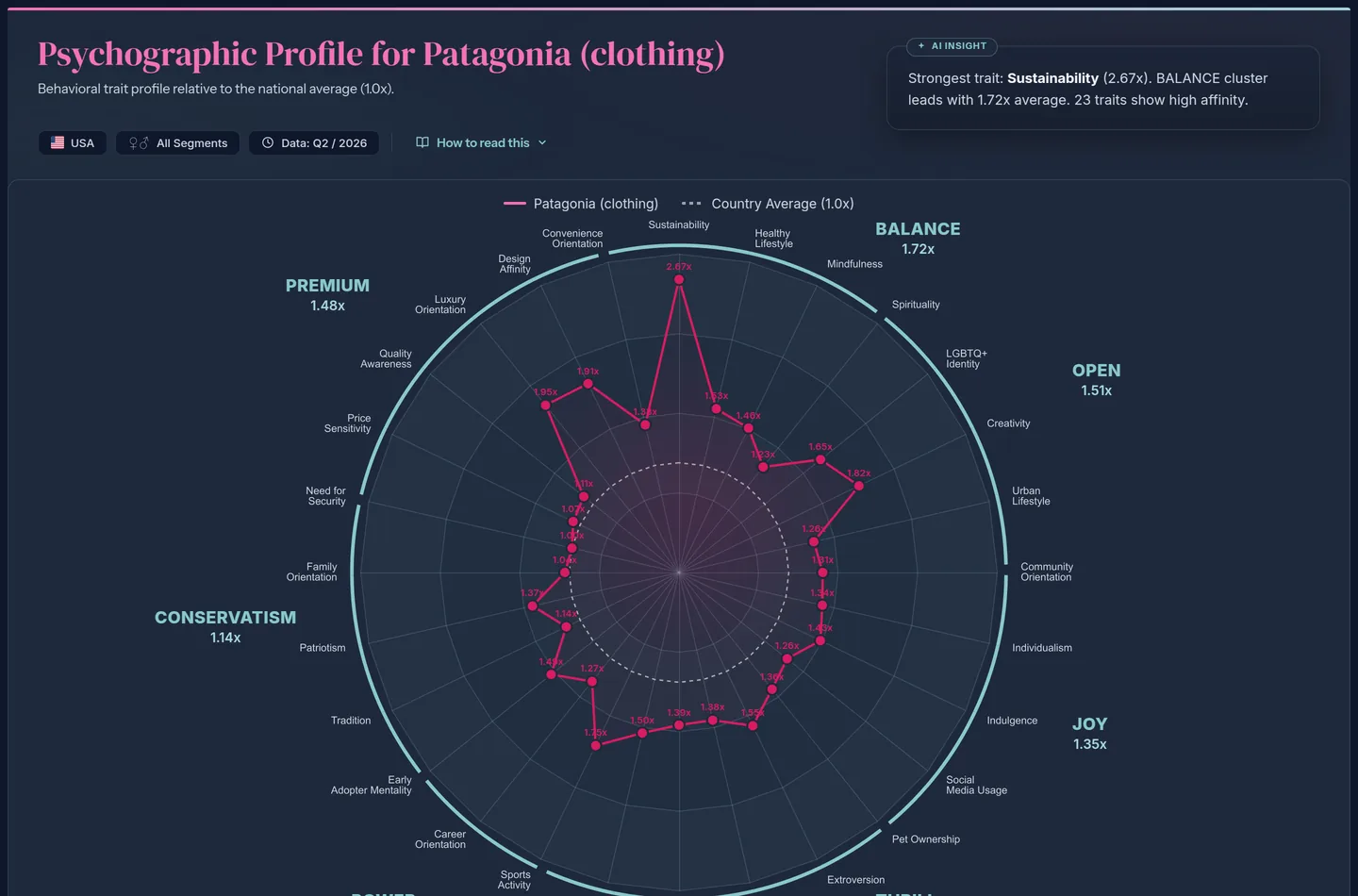
The psychographic profile places the audience on 23 traits, from sustainability and security to thrill and premium, each against the national average. It tells you how to speak to them.
- Sustainability is Patagonia’s strongest trait (2.67×)
- Balance leads the clusters (1.72×)
- Thrill and openness above average too
Everything they are into, in one picture
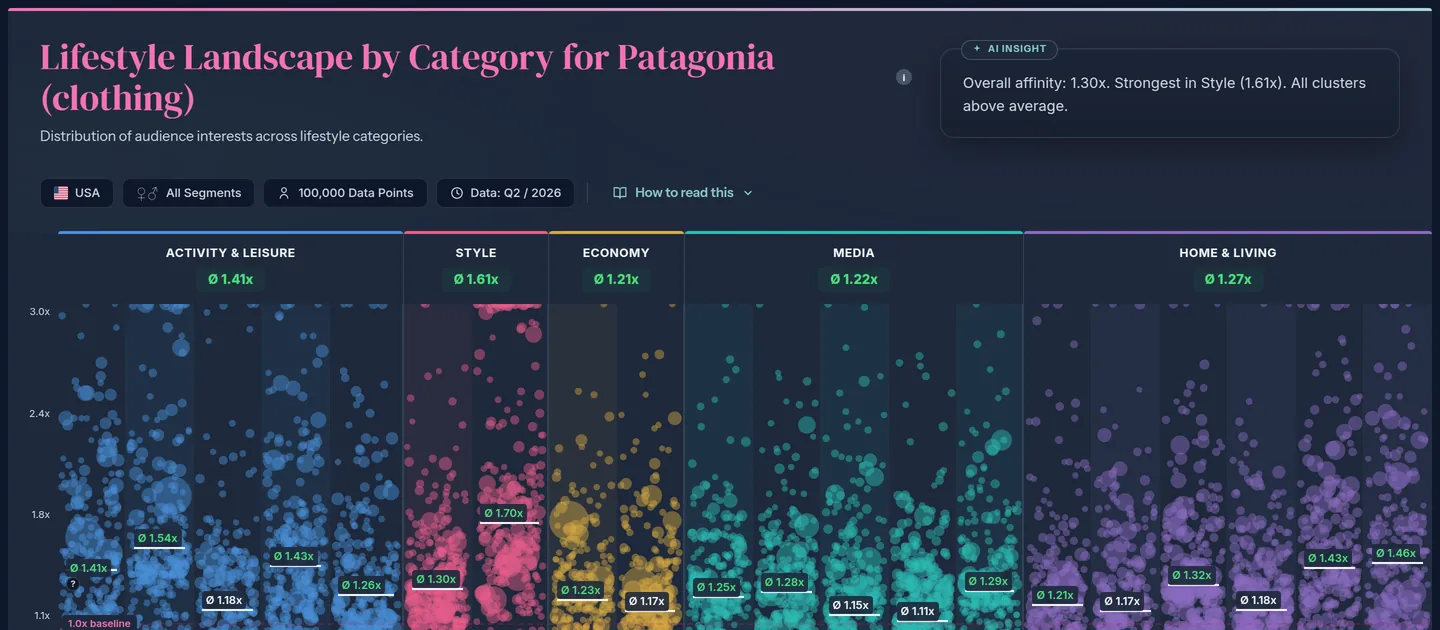
The Lifestyle Landscape shows all data points of the audience by category: every dot is a brand, medium, person, event or topic, placed by affinity. 100,000 data points for Patagonia alone.
Overall affinity 1.50×, strongest in Style (1.61×). Every category is above average.
Spotlights: the themes that set them apart
Spotlights group the data points into themes, so you see the story behind the numbers. Switch between them yourself:
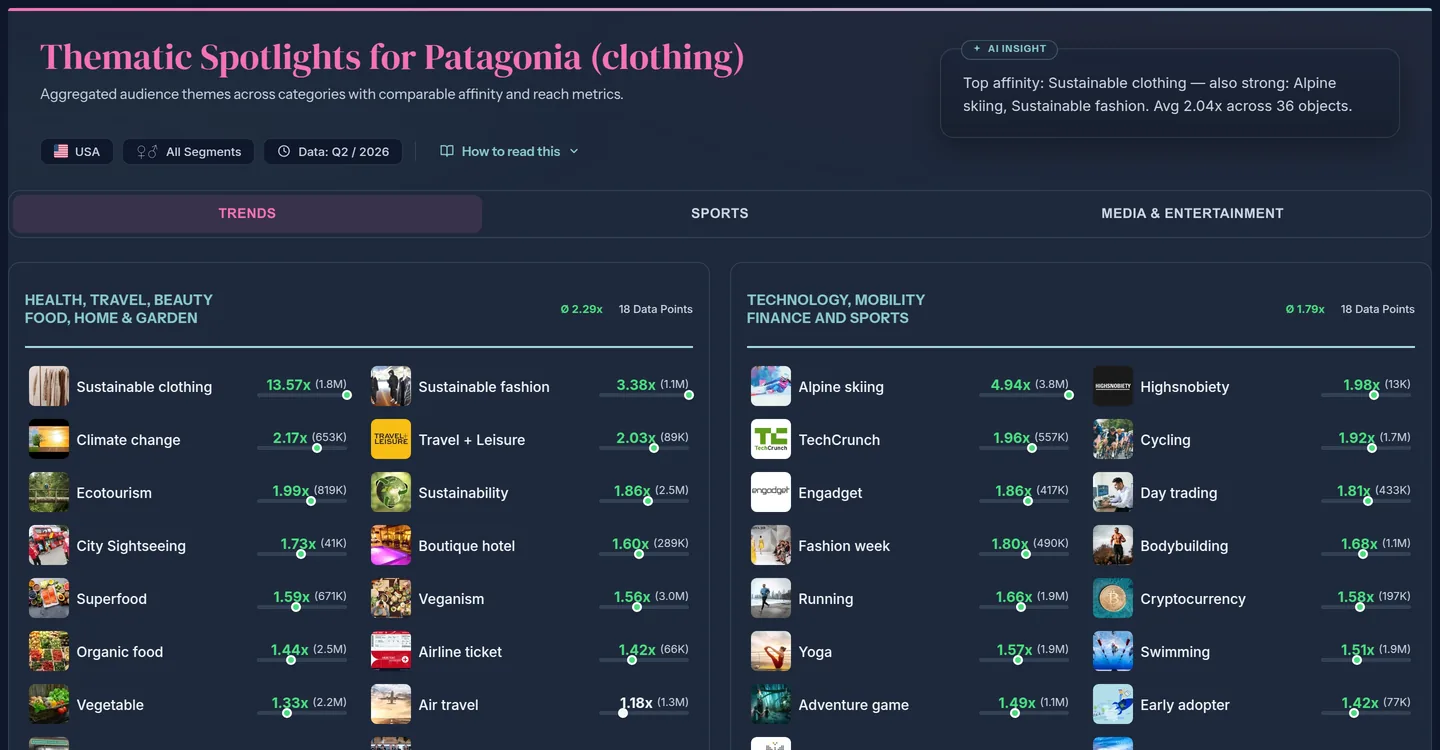
Sustainable clothing (13.6×), climate change, ecotourism, alpine skiing: the themes that set Patagonia’s audience apart.
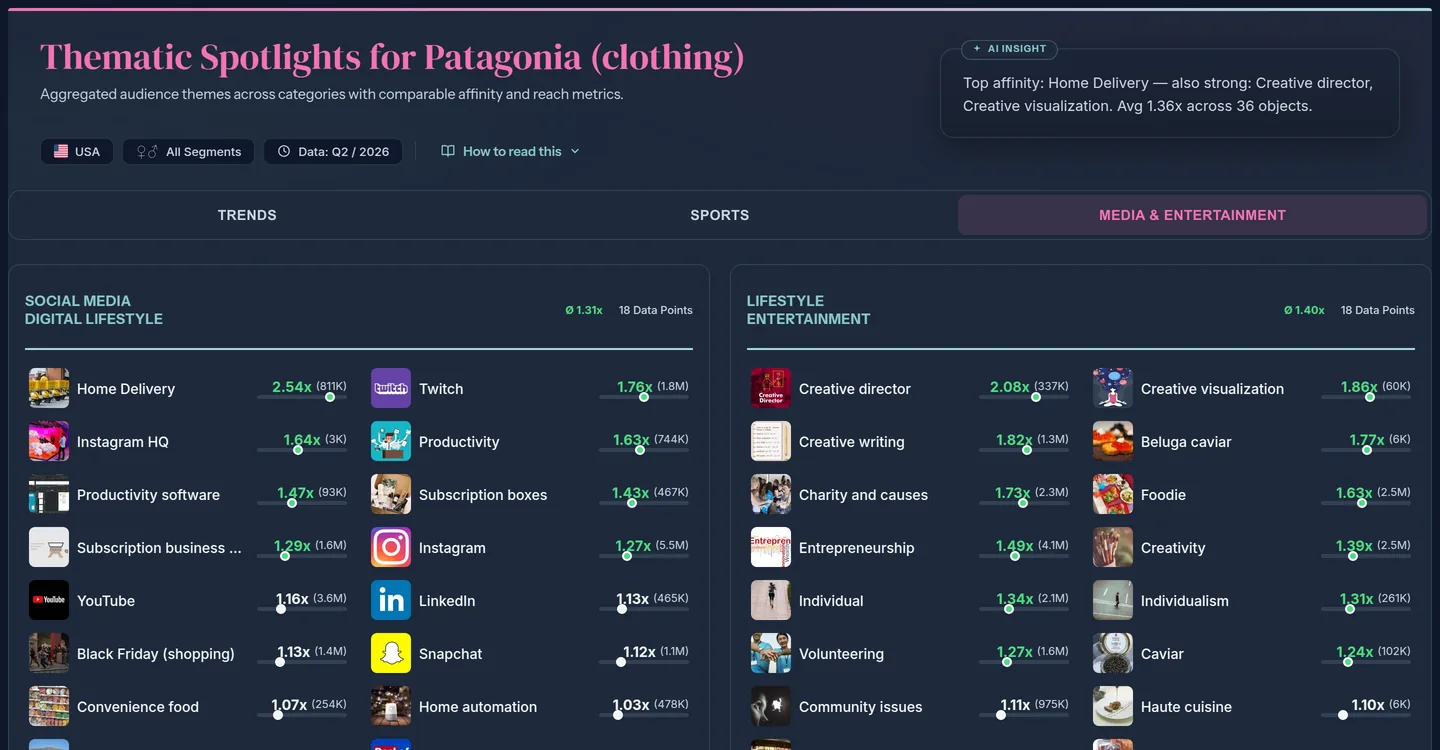
Home delivery, Twitch, productivity apps, creative work: where the audience spends its digital time.
By place, by postal code, by people
Every view works for any slice of the audience. Switch between them yourself:
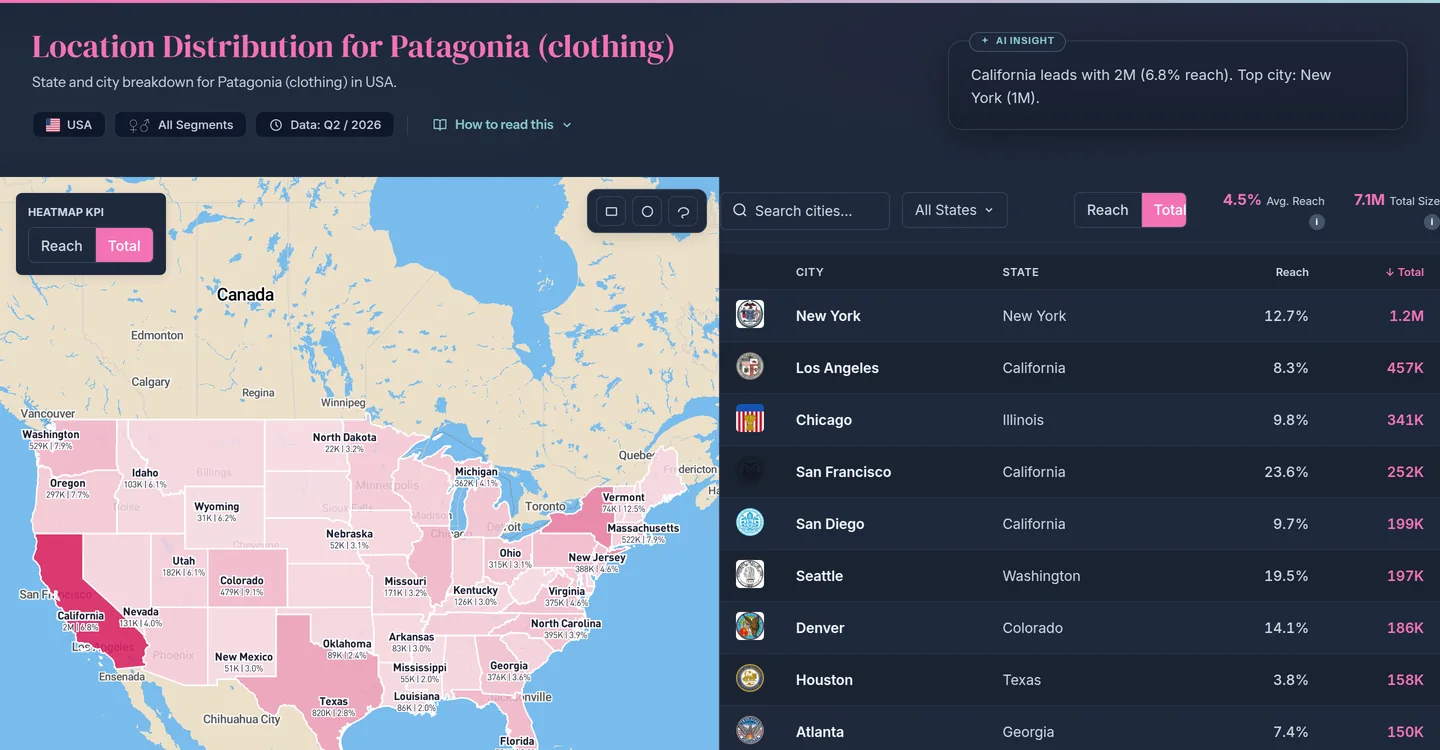
California leads with 2 million people, New York is the largest city.
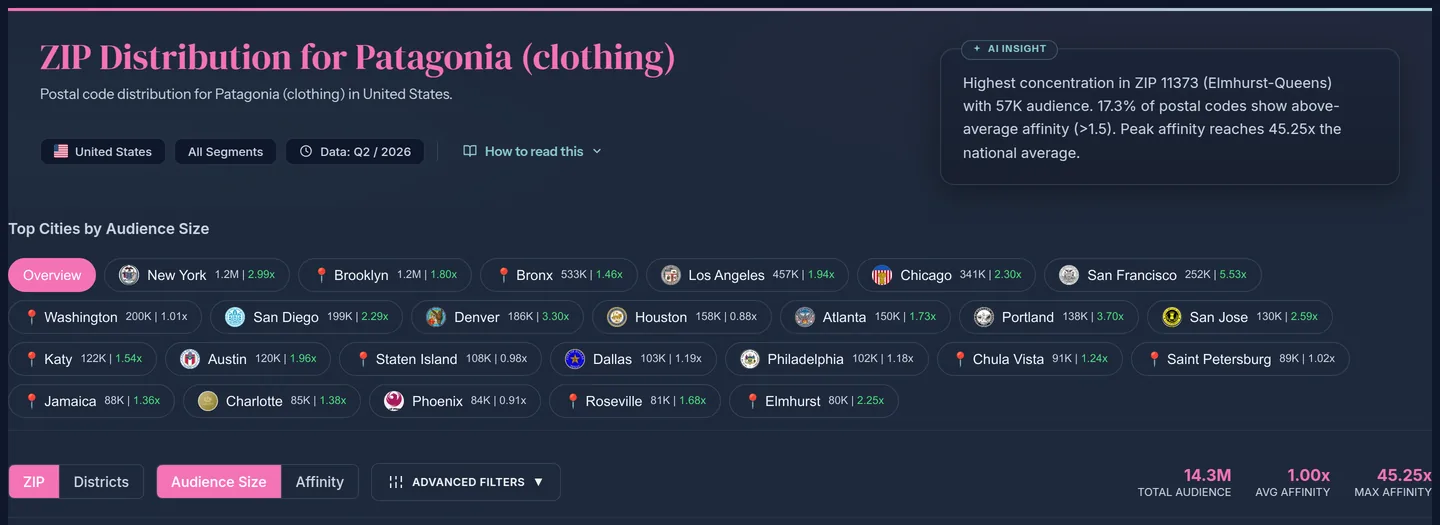
Down to ZIP code: the highest concentration is in 11373 (Elmhurst, Queens).
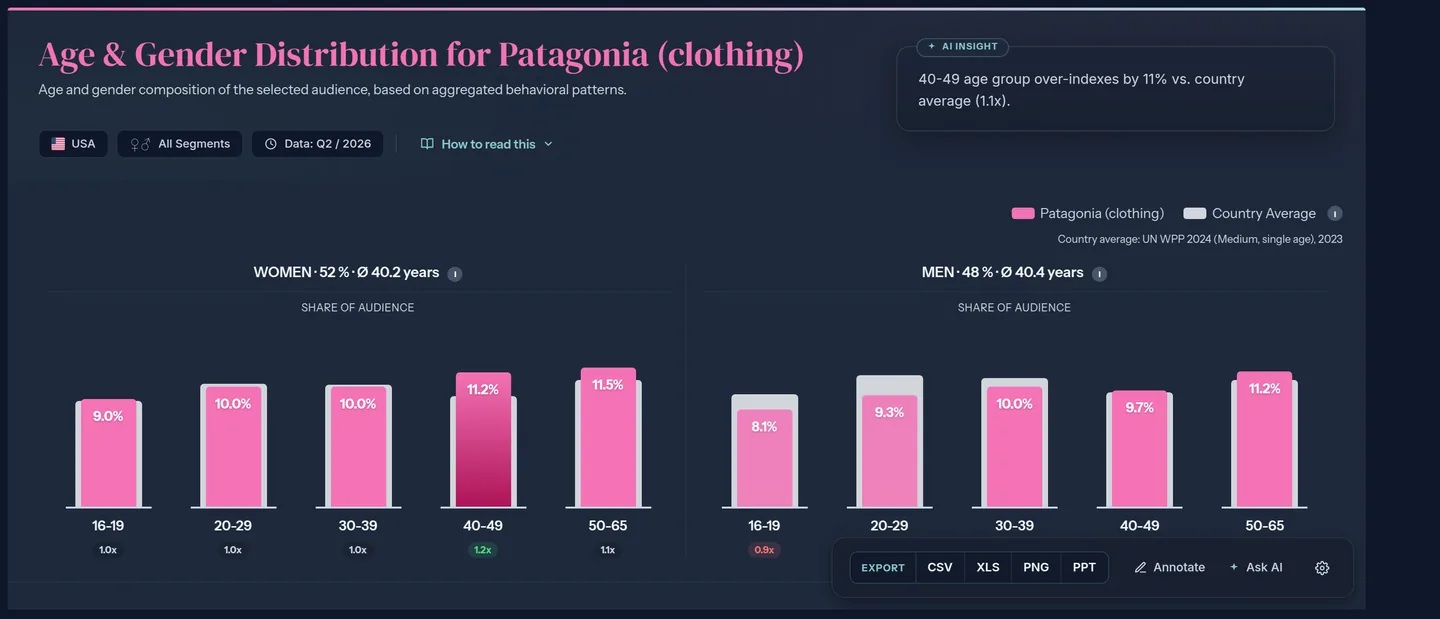
52 % women, average age 41. The 40–49 group over-indexes against the US average.
Rascasse inside Claude and ChatGPT
Connect Rascasse to your AI assistant through MCP and ask about any audience the way you would ask a colleague.
- Works with Claude, ChatGPT and other MCP clients
- Any audience, any market, any slice
- Available as part of your agreement, API included
14.3 million people in the US, 52 % women, average age 41. Interest peaks in November and December.
| Strongest signals | Affinity |
|---|---|
| Sustainable clothing | 13.6× |
| Columbia Sportswear | 7.8× |
| REI | 5.1× |
| Alpine skiing | 4.9× |
| Fly fishing | 4.6× |
The audience is outdoor-driven and values-led: sustainability is the single strongest signal in the whole profile.
What you get
An audience you actually know
Working with segments or personas? See Segmentation & Personas.
Start small
Start with a Proof Case
Your audience in one or two markets, the full profile and what it means for your plan. A fixed scope and a fixed price, presented to the people who decide, and credited against the Annual fee if you continue.
Audiences change faster than annual studies. Know yours before the next campaign is briefed.
Questions
Before you ask
Which audiences can you profile?
Any brand, club, artist, media title, event, place or topic, and any combination of them. More than 500,000 data points are available as building blocks.
How detailed is a profile?
Each audience is described by 100,000+ data points across all areas of life: brands, media, people, events, places and topics.
Can we use our own locations?
Yes. Besides countries, regions, cities and postal codes you can define custom locations, for example your store catchment areas.
Which demographics?
Age and gender in every market, ethnicity in the United States.
Where does the data come from?
From AI-based analysis of aggregated digital behaviour signals, not surveys: what people search, follow, watch and listen to, aggregated and anonymous. No panels and no questionnaires.
How fast is a new audience ready?
Usually within 24 hours.
Is this personal data?
No. We work with aggregated signals only: no names, no e-mail addresses, no individual profiles.
How do we start?
With a Proof Case: your audience in one or two markets, the full profile and what it means for your plan, at a fixed scope and price.
More in Audience Intelligence