
Home / Audience Intelligence / Advanced Demographics
Advanced Demographics · for clubs, brands, agencies and media
Beyond age and gender. Who your audience really is.
Age and gender are the start. Rascasse adds life stage, children in the household, the size of the places your audience lives in, education, languages and life events, each against the country average, so you know whom you are talking to before you plan a campaign, a product or a partnership.
- Age and gender against the country
- Household and city type
- Education, languages, life events
Used by brands, agencies, media and rights holders











How we read the signals
Your audience against the country. Group by group.
For every age group, household type, city size and demographic theme we compare your audience with the population of the country. Above 1.0× a group is over-represented, below 1.0× it is under-represented.
- Share: how much of your audience falls into each group
- Affinity: against the country average, so 2.0× means twice as likely
- Segments: every view sliced by age and gender, and in the US by ethnicity
What slows you down
Demographics that stop at age and gender
Share of women and average age say little about how people live.
A target group study from last year misses who your audience is today.
Families with young children and students need different offers and messages.
City or countryside changes media, distances and the whole matchday.
The audience against the country, age group by age group
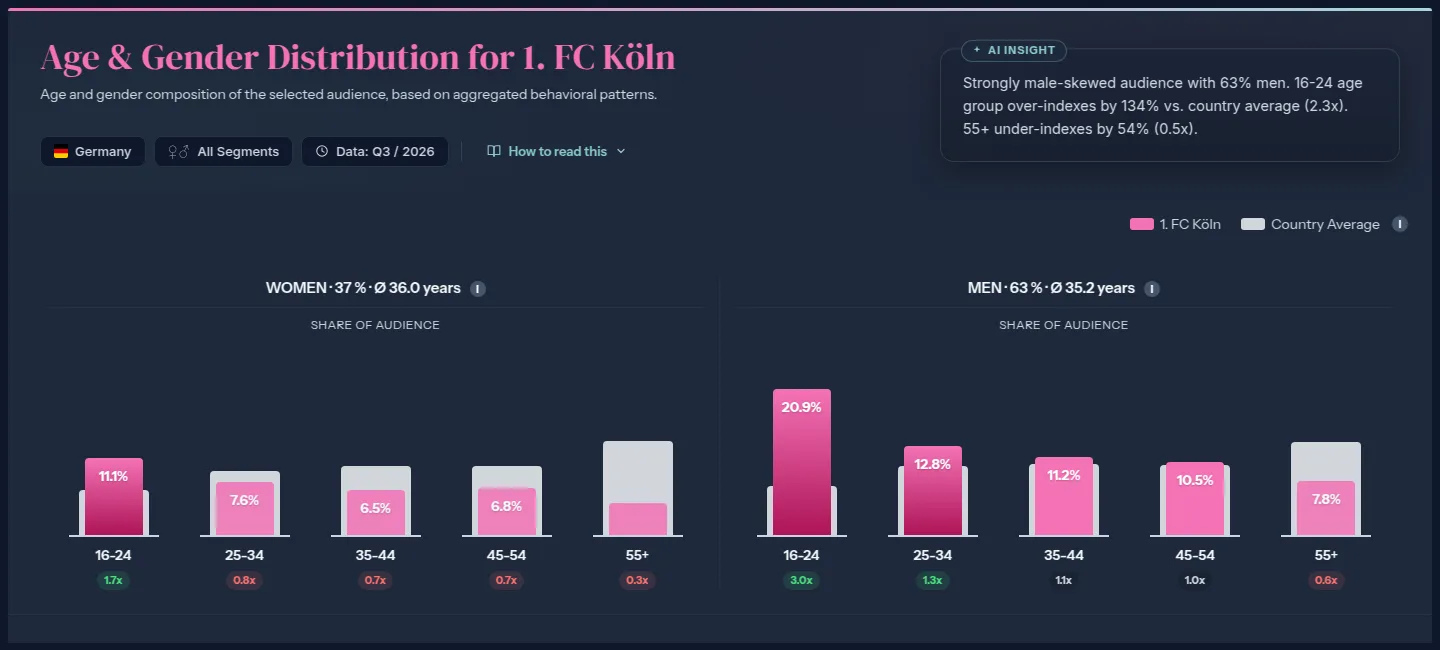
1. FC Köln in Germany: 63 % men. Men aged 16 to 24 are the largest group, at 20.9 % of the audience, three times their share of the population. Audiences over 55 are under-represented.
Children in the household, by age
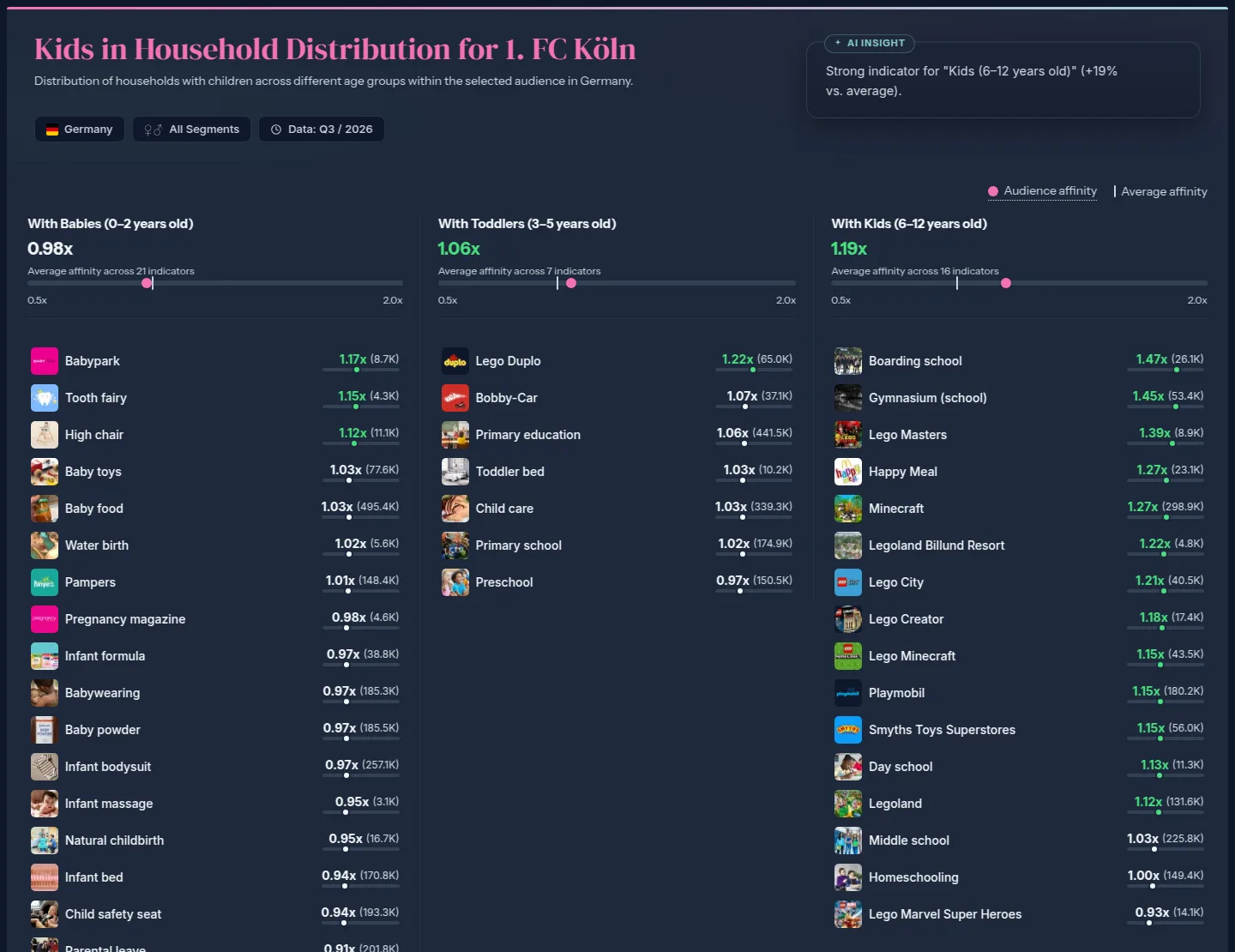
Households with babies, toddlers and school-age children, each with its own signals. For 1. FC Köln, households with children aged 6 to 12 stand out at 1.19×, led by boarding schools, Gymnasium and Lego Masters.
Big city, small town or countryside
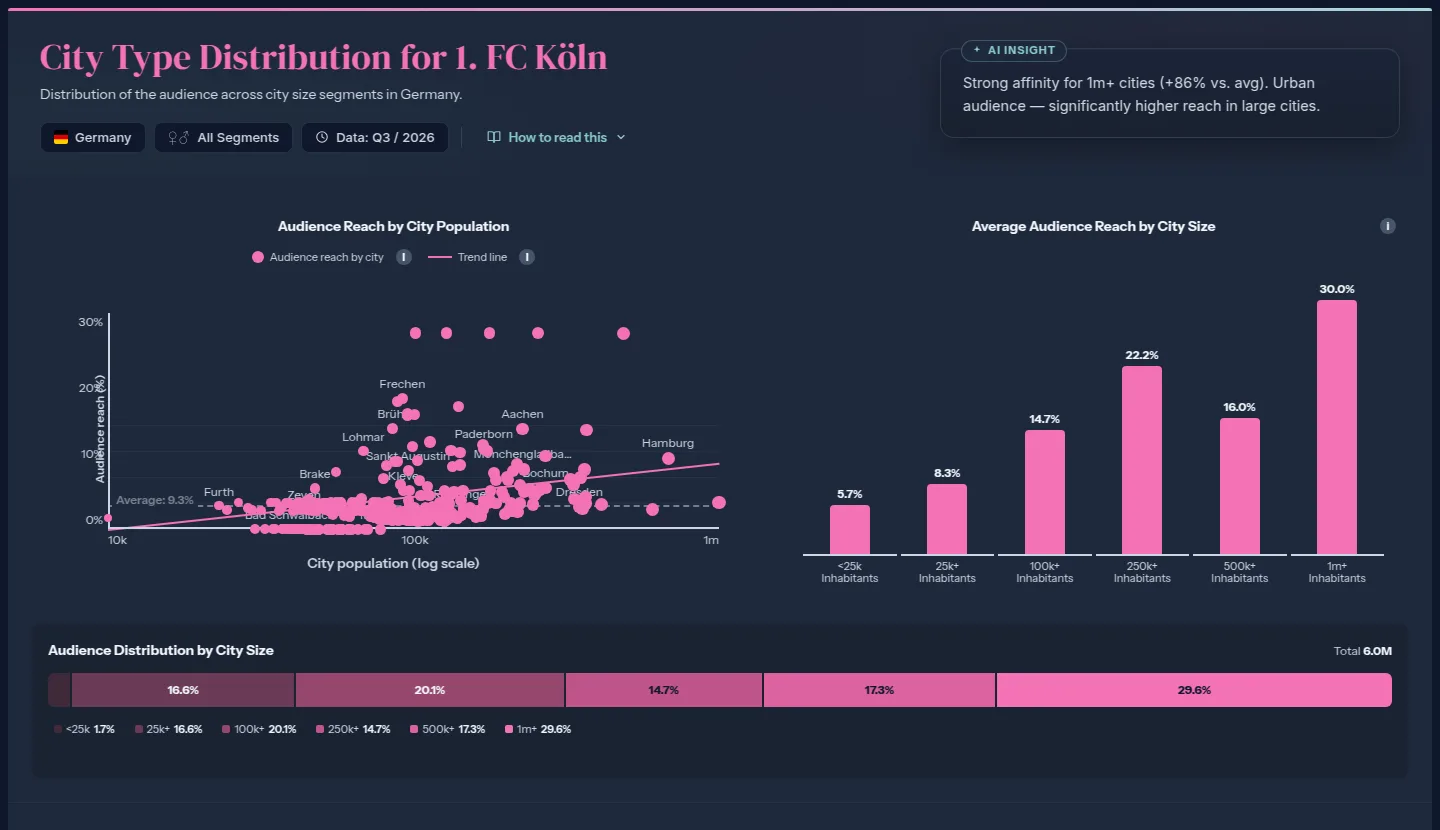
Reach by city size shows where your audience is concentrated. 1. FC Köln reaches 30 % of the people in cities with more than a million inhabitants, against 5.7 % in places under 25,000.
The themes behind the numbers
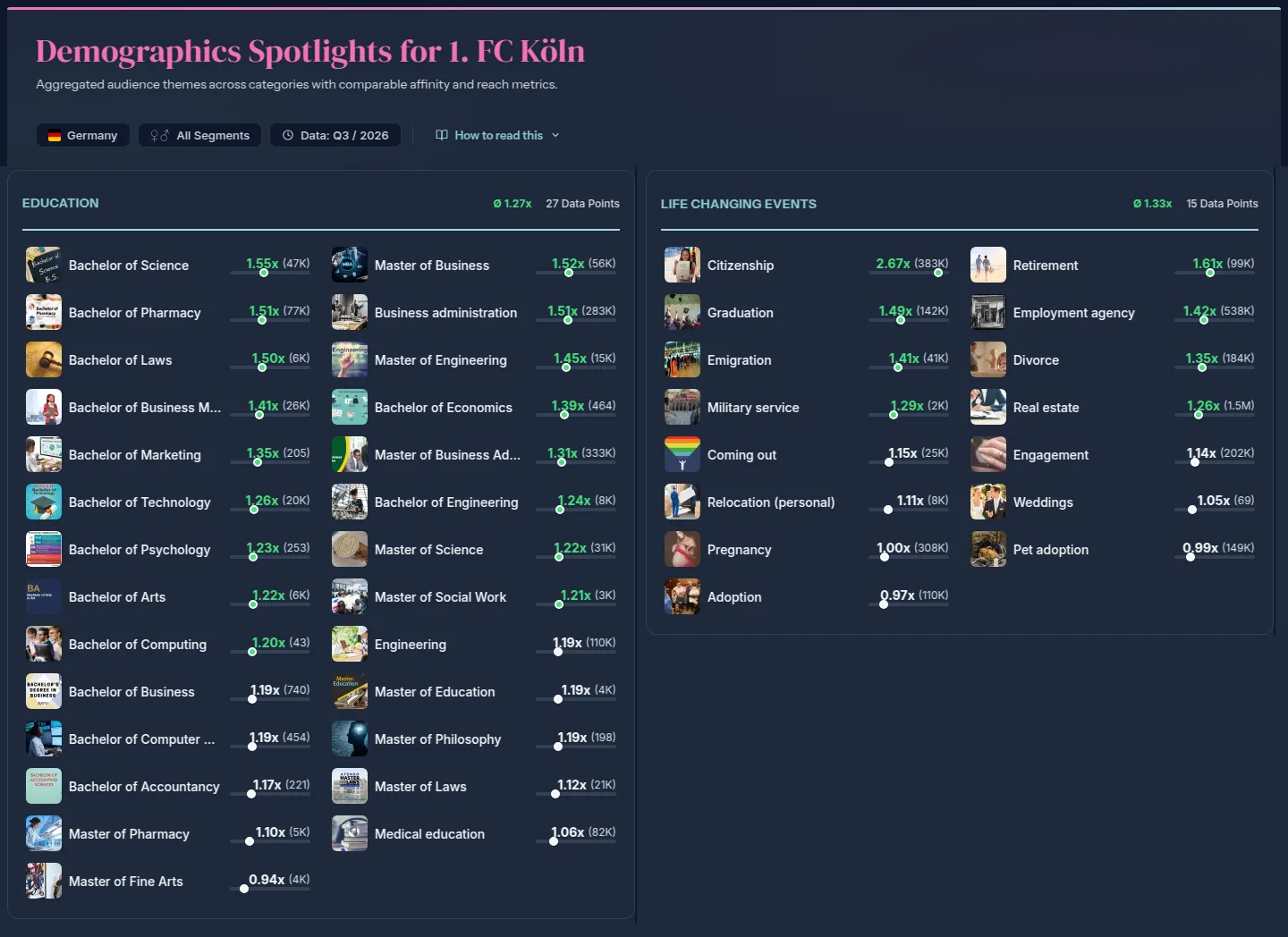
Demographic spotlights rank education, languages and life events by affinity. 1. FC Köln: degrees in science, pharmacy and law lead education, graduation and retirement stand out among the life events.
Rascasse inside Claude, ChatGPT, Copilot and Gemini
Connect Rascasse to your AI assistant through MCP and ask about your audience in conversation.
- Works with Claude, ChatGPT, Microsoft Copilot, Gemini and other MCP clients
- Any audience, any country
- Available as part of your agreement, API included
The audience in Germany:
| Signal | Value |
|---|---|
| Women | 36.7 % |
| Average age | 35.5 |
| Largest group | Men aged 16 to 24 |
A young, male core: men aged 16 to 24 are the largest single group, a fifth of the audience.
What you get
A target group you can describe in full
Want the full picture of interests, brands and media? See Audience Profiling. Building segments from these groups? See Segmentation & Personas.
Start small
Start with a Proof Case
Your audience in one market: age and gender, life stage, city type, education and languages, against the country average. A fixed scope and a fixed price, presented to the people who decide, and credited against the Annual fee if you continue.
Target groups are defined before the campaign starts. Bring the demographics into the briefing.
Questions
Before you ask
Which demographics are included?
Age and gender, children in the household by age, city size, education, languages and life events, each against the country average.
Can we slice by segment?
Yes. Every view can be filtered by age and gender, and in the United States by ethnicity.
Which countries?
Age and gender in 200+ countries. Household, city type and spotlight views depend on the market.
Where does the data come from?
From AI-based analysis of aggregated digital behaviour signals, not surveys: what people search, follow, watch and listen to, aggregated and anonymous. No panels and no questionnaires.
Is this personal data?
No. We work with aggregated signals only: no names, no e-mail addresses, no individual profiles.
More in Audience Intelligence